What I recommend to guests changes as autumn deepens. In summer the conversation is about squid and sashimi; once it turns cold I start saying, try senbei-jiru at least once. It is Hachinohe's own dish, and the name is literal: a rice-cracker-style wheat cracker, simmered in broth.
That description usually gets me a doubtful look. Won't the cracker go soggy and dissolve? It makes sense the moment you eat it, but knowing the reasoning first makes it more interesting, so here is what I explain to guests at Nvillage: what the dish is, why it holds together, where to find it, and when it is ready to eat.
What senbei-jiru actually is
Senbei-jiru is a hot pot. Broth is built from meat or fish with vegetables and mushrooms, and a wheat cracker made specifically for soup is broken into it and simmered. The most common version is a chicken broth seasoned with soy sauce, with vegetables and shirataki noodles. Japan's Ministry of Agriculture records it as a home dish eaten for roughly 200 years across northern Iwate and the Pacific side of Aomori.
The reason behind it is that rice did not grow well here. Cold summer winds were frequent, and by the late Edo period poor harvests and famine made rice hard to come by. Wheat and buckwheat were grown instead, and the nanbu senbei — wheat flour and salt pressed in an iron mould and baked hard — became a valuable stored food across the old Nanbu domain, from southeastern Aomori into northern Iwate. The ministry's entry on senbei-jiru sets out the history in full.
So this was never a celebration dish. It is a pot built out of what was on hand. What arrives at your table in Hachinohe is not a modern invention aimed at visitors, but something that came straight out of the kitchens here. It was named to Japan's national list of 100 rural local dishes in 2007.
Why the cracker holds its shape
This is the part people get wrong. The cracker used in senbei-jiru is not the sesame or peanut cracker you eat with tea. It is a separate product, known as otsuyu senbei or kayaki senbei, made only for soup.
According to the Hachinohe Senbei-jiru Institute, the soup cracker is made from wheat flour, salt and baking soda alone, by a method that assumes it will be simmered — which is why it does not disintegrate. Historically this is a postwar development: manufacturers worked out how to make a cracker that absorbs broth and turns chewy rather than falling apart, and began selling it specifically for the pot.
Which means the sesame crackers you buy as a souvenir will not make senbei-jiru at home. I have had guests try it, so it is worth saying plainly: buy the packet marked for soup or for hot pot, not the snack ones.
It is ready when it is al dente
When the pot arrives at the table, the cracker can still be firm. The institute describes the right moment as the texture of a well-made udon noodle with some bite — al dente, in pasta terms. That is the clearest guide I know of.
Simmer it longer and it keeps drinking the broth and softens. Some people dislike that stage; others prefer it. There is no single correct answer, so what I suggest to first-timers is to eat one piece early, wait a while, and eat another. Watching the texture change inside the same pot is a large part of the pleasure of this dish.
One practical note: the pieces break easily when lifted with chopsticks, so a spoon or a small plate makes them much easier to handle. This is not a noodle to be slurped — it is soaked wheat dough, and it eats like one.
Broth variations, and what "senbei-kayaki" means
Chicken and soy sauce is the standard, but this is a fishing port, so there are variations: a salt-seasoned version built on cod or grilled mackerel, a shortcut home version using canned mackerel, and a miso version with horse meat, a local speciality. Common solid ingredients are chicken thigh, pork, burdock root, carrot, cabbage, spring onion, shirataki and mushrooms.
The city's own newsletter publishes a household recipe, and the proportions are telling: for three to four people, ten soup crackers, 45g of chicken thigh, 20g of pork and a quarter of a burdock root. Strikingly little meat. The broth is the point, and the cracker is what carries it.
There is a second local term worth knowing. The institute defines senbei-kayaki as the practice of cooking an ordinary hot pot, then adding soup crackers once the solid ingredients have thinned out, so the crackers simmer in the accumulated broth. It is the local equivalent of the closing course of a Japanese hot pot. Senbei-jiru puts the cracker in from the start; senbei-kayaki finishes the pot with it. If you order a hot pot at an izakaya and are asked whether you want senbei added, this is what is being offered.
Since mackerel has come up: Hachinohe's mackerel and squid both have real seasons, and I wrote about the timing in a separate article. Senbei-jiru is served year-round, but if you specifically want the mackerel-broth version, read that one too.
Where to eat it: choosing among roughly 200 restaurants
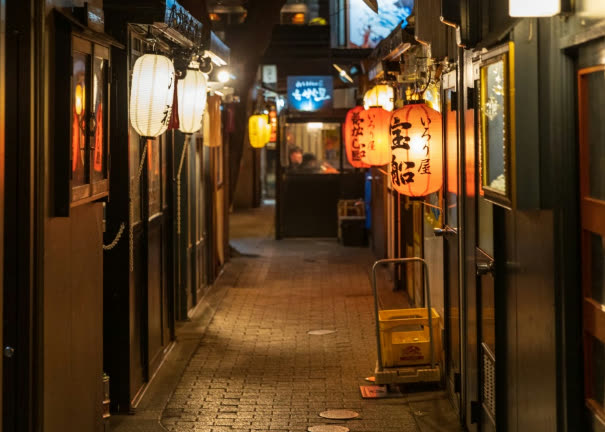
You do not need a special destination restaurant. Something close to 200 places in the city serve it, and the Hachinohe Senbei-jiru Institute publishes a guide map listing them. Broth and ingredients differ from one to the next, so the fastest approach is to open that list and find whatever sits near where you were already going.
The institute also runs a certification it calls the senbei-jiru hospitality meister: restaurant and tourism staff take a course covering the history of the dish, why a cracker goes into broth in the first place, and local tourist information. If you want the story alongside the food, choosing one of those places is the shortest route to it.
Three practical filters:
- For an evening with a drink, head to the yokocho alleys in the central district. A food-stall village like Miroku Yokocho packs small bars together and many of them serve hot pots — but hours are set per stall, and most open from around 17:00
- For lunch, aim at a diner in the town centre or a restaurant inside Hasshoku Center. Few yokocho stalls open at midday
- Solo travellers sometimes hesitate to order a pot. Many places serve a single portion, so the quickest thing is to ask at the door whether senbei-jiru is available for one
Which alley has which character, and what sits where in town, is covered in the area guide.
Hachinohe as the birthplace of the B-1 Grand Prix
Senbei-jiru became nationally known through the B-1 Grand Prix, a competition for regional everyday food — and the event itself started here. The Hachinohe Senbei-jiru Institute, a citizens' group formed in November 2003, planned and produced the first edition, held in Hachinohe in February 2006 with ten entrants. It was a small affair.
Senbei-jiru itself placed fourth at that first event. Then second three years running from the second edition, then third twice from the fifth: always just short. It finally took the gold at the seventh edition, held in Kitakyushu in November 2012. Winners are removed from subsequent voting, so that result stands as the end of the story rather than the start of a streak.
I tell guests this not to boast about the town but because I think it changes how the food lands. Eating a dish that the people here spent the better part of a decade pushing outward is different from eating an unfamiliar hot pot. It is the same reason I point guests toward the local makers we visit.
Taking it home: a kit, or just the crackers
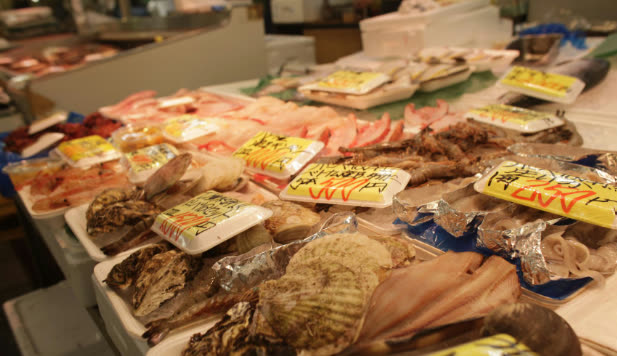
If you like it, it travels. There are broadly two ways to buy it.
- A kit — broth and crackers packaged together, or a heat-and-serve pouch or cup. Several versions exist. Good for someone who will not want to think about the cooking
- Just the soup crackers — cheaper and lighter if you are willing to make your own broth. They are a dry good, so they travel at room temperature
The two places I usually point people to are Hasshoku Center and the souvenir shop at Yu-tree, which connects to Hachinohe Station by an indoor passage. Yu-tree carries around 2,000 products from across the prefecture, so it works as a single stop before the shinkansen. Hasshoku Center is better if you want to look at the ingredients themselves; check its hours and closing days on the VISIT HACHINOHE listing.
One caution. Nvillage has no kitchen — the shared lounge has a fridge, a microwave and hot water, and that is all, so you cannot cook senbei-jiru at the guesthouse. Buy it to take home instead. Carrying it out of Japan is generally straightforward since it is a dry wheat product much like dried pasta, but whether it may enter your country is decided by that country's customs rules. Check before you fly if you are unsure.
Getting there from Nvillage
Nvillage is a 10–12 minute walk from the west exit of Hachinohe Station. For an evening bowl, the central-district yokocho are the obvious target. Hachinohe Station and the town centre are some distance apart, but you can either take a bus, or ride the JR Hachinohe Line from Hachinohe Station — the nearest station to us — to Hon-Hachinohe Station and walk from there to Miroku Yokocho. If you tell me before you arrive, we can work out how you will get back afterwards.
That said — and this surprises most guests — you do not have to go into town at all. There are places around Hachinohe Station itself, a short walk from us. Ikameshiya Hourin, inside the JR-East Hotel Mets Hachinohe attached to the station, serves senbei-jiru alongside ikameshi, the squid stuffed with rice that Hachinohe is known for. It runs straight through from midday into the evening, which makes it easy for a late lunch on your arrival day or a last bowl before you leave. Hours do change, so check the restaurant's own page before you go.
Check-in is self-service on a smart lock, so a late return keeps nobody waiting. The rooms are built for multi-night stays, and a jacket that has picked up the smell of a hot pot and a charcoal grill can be dealt with the same day in the washer and dryer. If you know what you want to eat but not where, that is fine — write to us from the contact page and we will work out lunch or dinner, and which part of town to aim at, around your dates.