When guests arrive in Hachinohe with nothing planned, we usually send them to Hasshoku Center first. Half a day there tells you what kind of town this is: a fishing port, a market that sells what the port lands, and a place where you can grill what you bought over charcoal without leaving the building. It explains Hachinohe faster than any sightseeing route.
Three things trip up first-time visitors, though. The bus leaves from the east side of the station, not the west side where Nvillage is. Opening hours are not the same across the building. And at the grills you have to check in before you shop, not after. Here is the whole thing in the order we explain it at the door.
What Hasshoku Center actually is
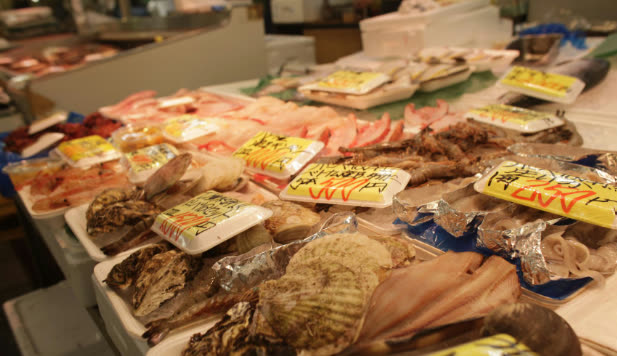
It is a large market on the edge of Hachinohe: a street about 170 metres long with several dozen shops selling fish, produce, meat, dried goods, sweets and sake. The fish landed at Hachinohe port goes straight onto these counters. This is not the wholesale market that trades before dawn — it is built for people to walk through and buy from.
What makes it worth a trip is that it does not stop at shopping. There are two eating halls inside, and a charcoal grilling area where you cook what you just bought. Market, restaurants and grill under one roof, which is why a visit tends to swallow a morning. Opening days and events are posted on the centre's own site.
The one piece of advice we always give: arrive hungry. Guests who eat lunch near the station first regret it every time.
Getting there: the 150-yen shuttle from the east exit
It is a little over three kilometres from Hachinohe Station. Walkable in theory, but it is a long trudge along a main road and you will be carrying more on the way back. Nobody we have hosted has walked it. Take the bus.
There is a direct bus between the station and the market. It used to be called the "Hasshoku 100-yen bus", and plenty of guidebooks and blog posts still call it that, but Nanbu Bus raised the fare to 150 yen on 1 April 2026, and the route is now the "Hasshoku 150-yen bus". If you set aside a 100-yen coin, it will not be enough.
- It leaves from the east exit of Hachinohe Station — the opposite side from Nvillage. Cross over the tracks on the free passageway inside the station. Getting this wrong costs you ten minutes
- The ride takes roughly 10 to 12 minutes. You can get off en route, and the fare is the same however far you go
- Board at the rear, pay at the front when you get off. Take a numbered ticket on boarding. IC cards (Suica, Pasmo and the rest) work
- It stops right by the Kuriya Stadium side of the building — no walk from the stop
- The bus runs even on days the market is closed. It does not run on 1 January
Departure times shift by season and by day of the week, so check the operator's timetable for the day you are going. Decide before you leave which bus you are taking out and which one you are coming back on: the last return is earlier than most people expect, and knowing it means you are not rushing your shopping.
Coming from downtown or Hon-Hachinohe Station
If you are staying downtown, a different bus serves the market. It changed in the same April 2026 revision and is now the "Hasshoku 250-yen-or-less (Ika) bus", running from the north exit of Hon-Hachinohe Station via the downtown terminal. Hachinohe Station and Hon-Hachinohe Station are two different stations, so which bus you want depends on where you slept.
By car it is about ten minutes from the station, and parking is large and free. If you have a rental car this is the easiest destination in the city, with the bonus that whatever you buy goes straight into the boot.
When to go: the halls keep different hours
This is the second thing people get caught by. It looks like one building, but it does not close as one. As of August 2026:
- Market hall and Aji-Yokocho — roughly 9am to 6pm, closed on Wednesdays (though they may open on Wednesdays in peak weeks)
- Kuriya Stadium, the main eating hall — roughly 9am to 9pm, open essentially every day
So a Wednesday evening can leave you able to eat but unable to shop. If the market is the point, avoid Wednesday — but because peak weeks are an exception, the reliable move is to check the official calendar for your actual date. The new year period also runs on its own schedule.
We push people towards the morning. The fish counters are at their fullest, and the grills are empty. By early afternoon the grill seats fill up, and by late afternoon the market counters start being packed away. First bus out, one full lap of the market, grilling by eleven — that is the version that wastes nothing.
Shichirin-mura: grilling what you just bought
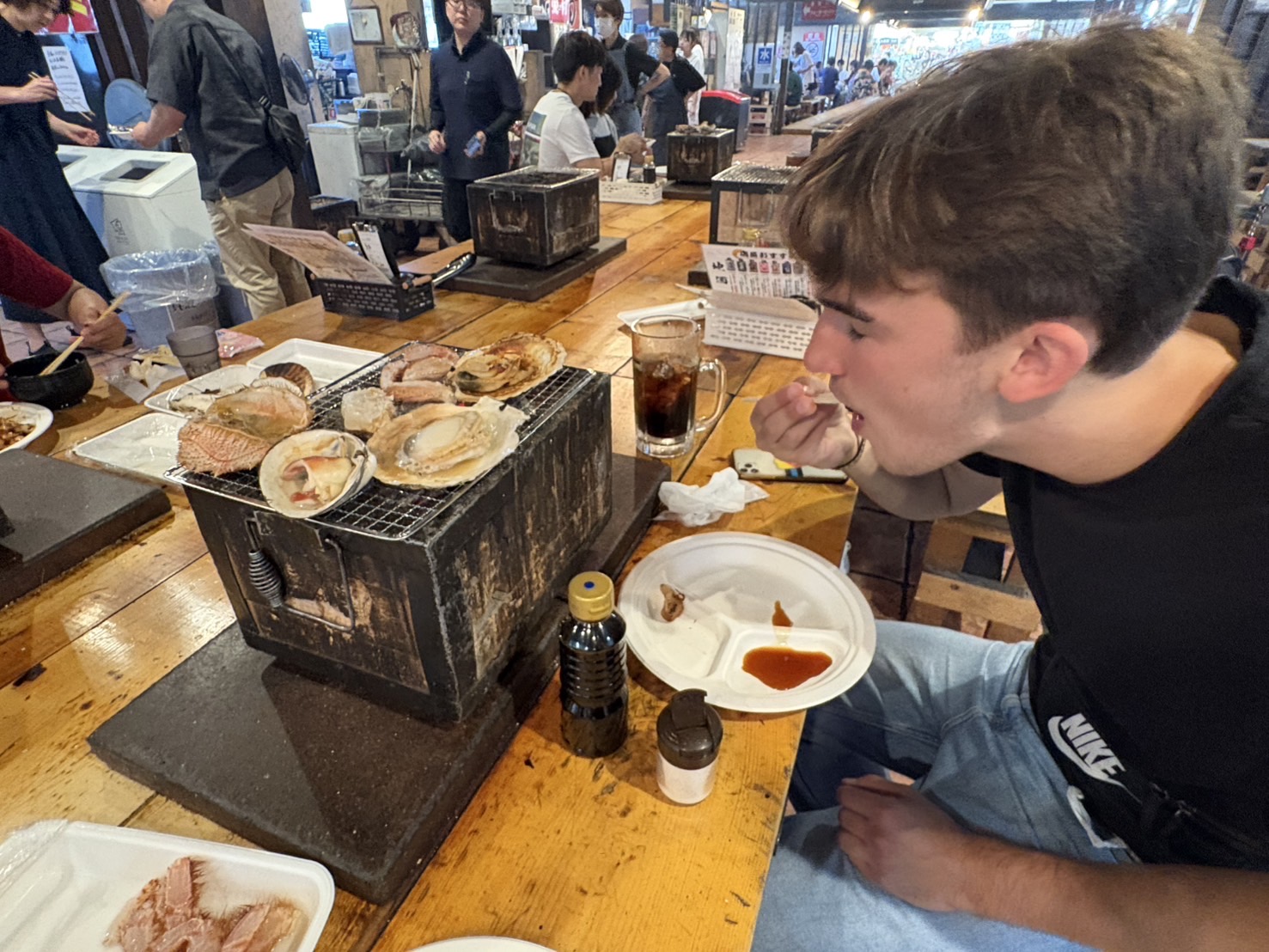
The grilling area is the reason to come. You carry in what you bought inside the building and cook it yourself over a charcoal brazier, with local families grilling meat at the next table. It is the part of Hachinohe our guests remember — it is where Marcus, who came from Sweden, ended up saying he had the best afternoon of his trip.
Check in first, shop second
This is the mistake we see most. If you buy your food first and walk over afterwards, you can find there are no seats. The grills' own page says the same thing: register before you shop. The order is:
- Go to the Shichirin-mura desk, say how many of you there are, and pay the seat fee. The desk stops taking people around 5pm
- You get a table and a set — brazier, charcoal, rack, tongs, seasonings
- Now go shopping. Your seat is held, so you can take your time choosing
- Come back and cook. You have two hours from when the seat was taken. Extra charcoal was free
As of August 2026 the fee is 500 yen for adults and 200 yen for primary-school children, with under-sixes free. Older posts online still quote 350 yen; that figure is out of date. Fees like this do get revised, so confirm on the official page before you go. Only food bought inside the building can go on the grill — you cannot bring food in from outside.
What to buy for the grill
For a first visit we suggest squid, scallops and other shellfish, and dried fish. Hachinohe has long been known as a squid port — there is more on the seasons in our article on mackerel and squid. Dried fish is forgiving: you can see when it is done. Grilling a whole raw fish is harder than it looks, so save that for a second visit.
- Overnight-dried squid — a light scorch is enough. Overcook it and it turns to rubber
- Scallops — straight onto the rack in the shell; when they open and the liquid bubbles, add a splash of soy sauce
- Prawns and shellfish — hard to get wrong, which makes them the choice when children are cooking
- Meat and vegetables — there are butchers and greengrocers too, so this works even with someone who does not eat fish
The commonest error is buying more than you can eat. Three or four items is plenty for two people. Your clothes will smell of smoke afterwards; there is no way around that.
If you would rather not cook
There are two eating halls. Kuriya Stadium has a conveyor-belt sushi restaurant fed directly by the market, which is a different proposition from conveyor-belt sushi at the same price anywhere else. Order one of the tasting sets of squid or mackerel and you have covered the local catch in one sitting.
Aji-Yokocho leans towards set meals and noodles, including local dishes. If you are hunting for senbei-jiru, see our guide to it. The eating halls stay open later than the market, so they rescue an afternoon that started too late.
What to take home
The only real question is whether it survives at room temperature in your bag. If you have more travelling to do, dried goods, snacks, sweets and sake beat fresh fish. Smoked squid and Nanbu senbei crackers are light and don't crush.
If you do want something fresh, some shops will ship it for you within Japan, which is more reliable than carrying it and keeps your luggage light. Taking seafood out of the country is a different matter: import rules vary by destination, so check your own country's quarantine rules before you buy. The shop cannot answer that for you.
Questions guests actually ask
- Payment — bring cash. Some shops take cards and e-money, but not all of them, and the market is the part of Hachinohe most likely to be cash-only
- Language — English is limited, but pointing works. You do not need the name of the fish; a gesture for how much you want is enough
- With children — the grill area is spaced out and full of local families. Children's fees are lower and under-sixes were free
- Rain — it is all under a roof, so this is the reliable wet-weather destination in Hachinohe
- Luggage — don't go with a large suitcase. Drop it at your accommodation first
Going from Nvillage
Nvillage is a 10 to 12 minute walk from the west exit of Hachinohe Station. On a market day that means walking to the station, crossing to the east side through the free passageway, and taking the bus — about half an hour door to door.
You will come back smelling of charcoal. There is a washer and dryer here, so that is dealt with the same evening. Anything you bought can go in the fridge in the shared lounge, but there is no kitchen, so plan on doing your cooking at the grills rather than back at the house.
Where to go afterwards is covered in the area guide and the experiences pages. The rooms are set up for multi-night stays, so market on day one and coast on day two works well. If you only know how many nights you have and nothing else, write to us through the contact page and we will work out the plan, bus times included.