After the sea, the question I get most is what to eat here. My answer barely changes: mackerel and squid. Hachinohe Port lands more squid than any other port in Japan, and the local mackerel is branded under its own name, Hachinohe-maeoki saba. But both have a real season. Arriving a month early or a month late genuinely changes what is on the plate.
What follows is what I actually tell guests at Nvillage before they go out to eat: when the season is, where to buy, what to ask for. Market days and the brand window are set fresh each year, so confirm the specifics on the operators' own pages before you travel.
The short answer: when each one is in season
- Squid (Japanese common squid) — landed July to December. Locally it is called summer squid, and fresh squid is most abundant from around August to November
- Mackerel (Hachinohe-maeoki saba) — the brand certification window is decided anew each year, and in recent years it has fallen in late autumn and winter
- Want both? Come in autumn or early winter, where the end of the squid season overlaps the start of the mackerel window
So a midsummer trip built around mackerel often misses, and a midwinter trip built around fresh squid often misses too. Every year someone arrives and says they came to Hachinohe for the mackerel and there was none. If you read only one section of this article before booking your dates, make it this one.
Hachinohe-maeoki saba: a fish with a certification window
Hachinohe-maeoki saba is not simply a place name. It applies to mackerel caught in waters including the grounds about 50 km east of Hachinohe, where the water sits at 16–18°C, landed at Hachinohe fishing port, and only during a window the industry council certifies. It is a brand with dates attached — which is the part visitors find hardest to follow.
That window is set each year on the basis of landings, fat content and the weight of the fish, with the fat analysis commissioned from an independent laboratory. For the 2024 season, for example, certification ran from 21 November 2024 to 20 January 2025. It can shift by around a month either way, so check the current year on the council's own site (it was renamed the Saba no Machi Hachinohe Council in July 2024).
The numbers make the point better than adjectives. The council reports that at the peak of the season, fish over 600 g can reach 30% fat, and even smaller fish of around 400 g exceed 15%. Eaten raw or lightly cured, you can feel that fat melt rather than simply taste it.
It is served cured as shime-saba, pressed into stick sushi, simmered in miso, salt-grilled, or dried. For a first taste I suggest the cured or raw version: the fat shows most honestly there, whereas starting with the miso-simmered version can leave you thinking it was merely a well-made mackerel. If you want to take some home, dried mackerel travels best — buy it on the morning you leave so it spends as little time as possible out of a fridge.
Squid: Japan's biggest landings, summer into winter
Hachinohe lands more squid than any port in Japan — Japanese common squid from nearby waters and the Sea of Japan, plus neon flying squid from the North Pacific. The processing plants and cold stores that can handle squid are clustered around this port, which is why the catch ends up here in the first place.
The common squid season runs July to December, and fresh squid is most plentiful from about August to November. In that window, squid landed in the morning reaches the counter the same evening, and the texture is not comparable to squid that has travelled. Show a guest how to stir the liver into the soy sauce and they almost always order a second plate.
One thing I tell people straight. Catch quotas now govern the fishery, and when a quota is reached the season can close earlier than planned. Landings at Hachinohe overall have fallen sharply over the past decade: city fisheries statistics show annual landings of close to 100,000 tonnes in the late 2010s against figures in the low 20,000s in recent years. Come expecting mountains of cheap fish and you will find a different port than you imagined.
What has not changed is the distance between the boat and the plate — what was landed this morning is on the counter tonight. Going to look at the sea itself is a separate trip, covered in our guide to Tanesashi Coast and Kabushima.
The two morning markets close on opposite days
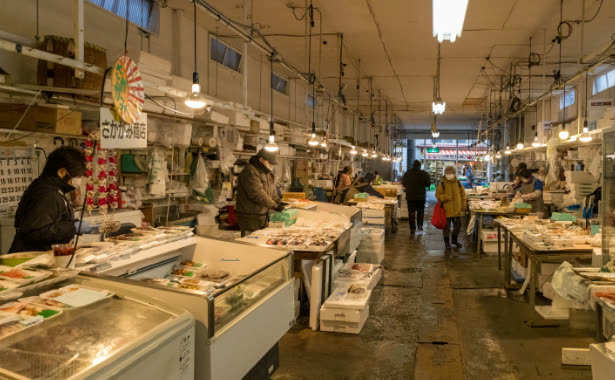
Hachinohe has two morning markets with completely different characters, and mixing them up is how people miss both.
- Mutsu-Minato Ekimae morning market (the municipal fish and vegetable market) — right by Mutsu-Minato Station on the JR Hachinohe Line, roughly 3:00 to 15:00, though the fresh fish and sashimi stalls close before midday. Shut on Sundays, the second Saturday of each month, and 1–2 January. Details on the city's page
- Tatehana Wharf morning market — Sundays only, from mid-March to late December. It starts at sunrise and winds up around 9:00; by about 6:00 some 300 stalls stretch along roughly 800 metres of quayside. Dates on VISIT HACHINOHE
Mutsu-Minato is closed on Sunday; Tatehana is open only on Sunday. Their closing days are exact opposites. As soon as a guest's arrival date is fixed, this is the first thing I check, because it decides the answer for them: Sunday morning in Hachinohe means Tatehana, a weekday morning means Mutsu-Minato.
What makes Mutsu-Minato worth the early alarm is that you assemble your own breakfast. Buy rice (about 100 yen a bowl) and miso soup inside the market, then top it with sashimi and side dishes bought from the stalls. When someone tells me they have no idea what to buy, I say: start with one pack of sashimi and a bowl of rice, then add as you walk. I have seen plenty of people overbuy and nobody go hungry.
Either market means leaving the house between four and five in the morning. Getting around from the west exit is covered on our access page.
Hasshoku Center: buy it, then grill it yourself
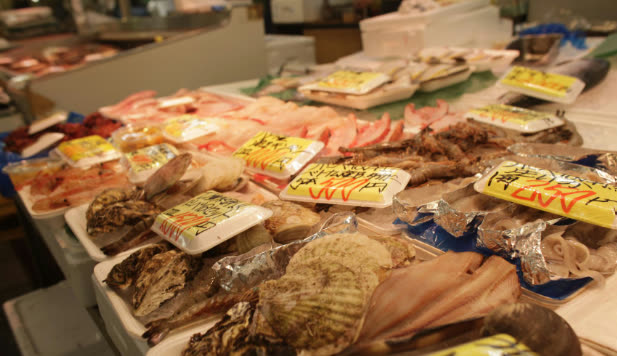
If mornings are not your strength, go to Hasshoku Center instead. It is a market that has become a destination in its own right: rows of fishmongers, and in one corner Shichirin-mura, where you grill what you just bought over charcoal at your own table. Both squid and mackerel are there.
Hours differ by building — the market hall and Aji-yokocho run 9:00 to 18:00, the Kuriya Stadium food court to 21:00. It closes on Wednesdays, though it sometimes opens on those days in peak season. Check current hours on VISIT HACHINOHE's listing. A direct bus runs from Hachinohe Station; fares are revised from time to time, so confirm before you board.
One thing about the house itself: Nvillage has no kitchen. The shared lounge has a fridge, a microwave and hot water, and that is all. So grilling is something to do at Shichirin-mura rather than here. What you can bring back and eat at the house is what is already ready to eat — sashimi, salted preserves and the like. Dried fish is sold raw and has to be grilled, so either grill it at Shichirin-mura while you are there or buy it strictly to take home. Most morning-market overbuying ends up in the lounge fridge.
Ordering at an izakaya: look for the brand name
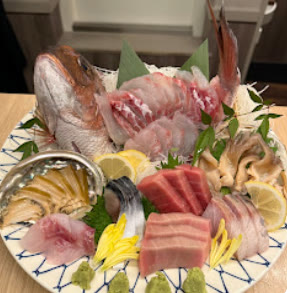
If a menu names Hachinohe-maeoki saba, you are inside the certified window. If it just says mackerel, it may be local fish out of season, or mackerel from somewhere else entirely. Neither is a problem — the point is simply that the name on the menu tells you what you are eating.
The most reliable move is to ask what is good today. Say you would like the best thing they have, and most places start you on local sashimi. If your Japanese is shaky, pointing at the assorted sashimi on the menu works fine. After rough seas the choice thins out, and on those evenings I tell guests not to insist on sashimi: grilled and simmered dishes will make for a better meal.
Which yokocho to head for, and which doors are easy to walk through, is in our area guide. Many guests pair an evening like this with one of our local experiences, visiting the people who make things here.
Four things that keep a food trip from misfiring
- The brand window and the fishing season are reset every year. Check this year's dates on the official pages before you travel
- The markets run on fixed days and close early. Mutsu-Minato is shut on Sunday, Tatehana runs only on Sunday, and both finish in the morning
- Rough weather means no fishing, and the next day's market and izakaya menus are visibly thinner
- If there is one thing you must eat, go for it early in the stay and keep a spare day later. If it falls through, you still have days left to try again
When you build a trip around seasonal food, leaving one spare day makes the whole trip easier. The guests who stay several nights are, unsurprisingly, the ones who go home having eaten well.
Doing this from Nvillage
If you are here for the fish, base yourself near Hachinohe Station: the Hachinohe Line to Mutsu-Minato starts there, and so does the bus to Hasshoku Center. Nvillage is a ten to twelve minute walk from the west exit, with smart-lock self check-in, so slipping out at four in the morning for the market wakes nobody.
The rooms are built for multi-night stays, and clothes that picked up the smell of a fish market can be dealt with the same day in the washer and dryer. If you know what you want to eat but not yet when you can come, write to us through the contact page — we will work out the timing with you around this year's certification window and the market days.