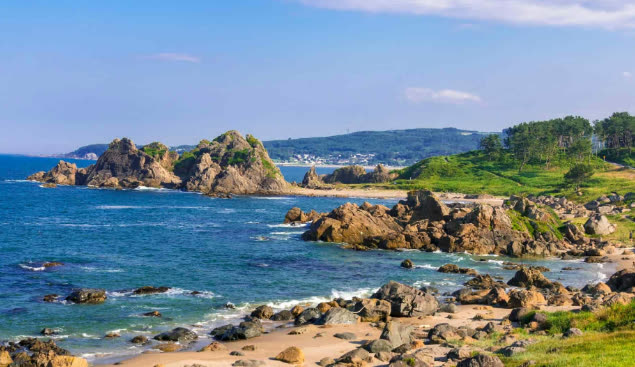
The question guests ask most often is where to see the sea. Hachinohe has coastline everywhere, but if you only get one trip, make it Tanesashi Coast and Kabushima. Both sit inside Sanriku Fukko National Park, about thirty minutes by local train from Hachinohe Station West Exit, where Nvillage is. The best thing about this stretch of coast is that you do not need a rental car to see it.
What follows is what I end up explaining to guests before they set off: how to get there, when to go, where to get off and how far to walk. Timetables and operating days change, so confirm the specifics on the operators' own pages before you leave.
Getting there: one local line, no transfers
Take the JR Hachinohe Line from Hachinohe Station. No changes. For Kabushima get off at Same Station, around twenty minutes out; for the Tanesashi lawn stay on to Tanesashi-Kaigan Station, around thirty-five. The lawn is a three-minute walk from its station, and Kabushima about fifteen minutes from Same. Either way, you step off the train and the sea is right there.
The thing to plan around is frequency: roughly one train every one to two hours during the day. If you treat it like a city line and assume you can catch the next one, you will spend two hours on a beach waiting. Pick your train back at the same time you pick your train out — that is the whole trick to this line.
The other option is the Umineko sightseeing bus, which runs between Same Station and Tanesashi-Kaigan Station and stops at Kabushima, the Ashigezaki lookout, Osuka beach and the Tanesashi lawn in turn — useful if you would rather not walk the whole way. In the 2026 season it runs daily from 1 April to 8 November, and weekends and holidays only in winter. Check days and times on the city's own bus page.
Getting around from the west exit in general is covered on our access page.
Kabushima: forty thousand gulls, and a shrine where you borrow an umbrella
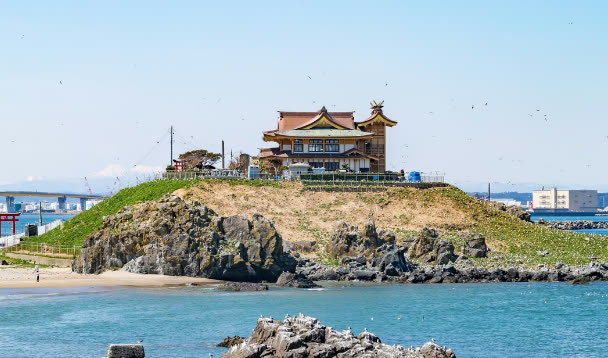
Kabushima was designated a national natural monument in 1922 as a breeding ground for black-tailed gulls. It is said to be the only place in Japan where you can watch them nest this close, and in season thirty to forty thousand birds cover the island. You are not looking at them through a fence from a distance — they fly and call directly over the path you are walking. What surprises first-time visitors is not the sight but the volume of it.
The birds arrive around March, lay in April, the chicks hatch in June, and by mid-August they have finished raising them and left. So the season is spring through summer. From September the island is quiet, which is lovely in its own way, but if you are coming specifically for the gulls, choose your month.
On top of the island stands Kabushima Shrine, founded in 1296 by tradition and dedicated to Benzaiten, long associated with fishing and business. The hall was lost to a fire in November 2015 and rebuilt over roughly five years.
And one piece of advice I never skip: they lend umbrellas for free near the torii gate, and you should take one. Look up and you will understand why. That said, if you do get hit, the shrine office will issue you a certificate of good fortune — in Japanese the word for droppings landing on you sounds like luck landing on you. Every guest I explain this to promptly lowers the umbrella and starts looking up.
Ashigezaki lookout and Osuka beach
South of Kabushima, on a headland, is the Ashigezaki lookout — a stone structure like an old watchpost, with the Pacific opening out flat in front of it. The wind comes straight off the water here, so bring a layer even in summer.
Beyond it runs Osuka beach: a long straight stretch of sand with very few people on it and almost no sound except the waves. This is a beach for walking rather than swimming. Plenty of guests walk it one way and take the bus back.
The Tanesashi natural lawn, where grass meets the waterline
If one photo has to explain this coast, it is the Tanesashi natural lawn. Grass grows almost to the water, then rock, then the Pacific. Blue and green running into each other like that is genuinely rare on the Japanese coastline.
More than 650 plant species grow along this coast, flowering in succession from early summer into autumn — which is why it is also called the flowering shore. You can sit straight down on the lawn, so the most luxurious way to use it is to bring something you bought in town and eat it here. The markets and the yokocho are covered in our area guide.
If you want to walk: the Michinoku Coastal Trail
Everything above is joined by a single path. The Michinoku Coastal Trail runs from Hachinohe in Aomori all the way to Soma in Fukushima, and the Hachinohe section is its northern end: Same Station to Kabushima, the Ashigezaki lookout, Osuka beach, the Tanesashi lawn, and on to Okuki Station. Route information is on the Ministry of the Environment's official trail site.
You do not have to walk all of it in a day. What I suggest to guests is to start at Same and either pick up the Umineko bus when you have had enough or take a train back from whichever station you reach. Both escape routes exist the whole way, so you can stop wherever your legs decide.
The Tanesashi Coast Information Center
Right in front of the lawn is the Ministry of the Environment's information centre, and admission is free. It explains the geology and wildlife of the coast, and the staff can tell you the state of the trail and what is worth seeing that week. It opens 9:00–17:00 from April to November and 9:00–16:00 from December to March, closed 29 December to 3 January.
Stopping here first changes how you spend the next hour. Which flowers are actually out that day is something you will not learn anywhere else.
What each season looks like
- Spring (March–May) — the gulls return to Kabushima and start laying. The wind is still cold; bring a jacket
- Early summer (June–July) — chicks hatch and the island is at its loudest, with more flowers out on the lawn
- Summer (August) — the gulls leave. This is when the blue and green of the lawn are at their sharpest
- Autumn (September–November) — fewer people, a quiet sea, and the most comfortable walking of the year
- Winter (December–February) — strong wind, and the Umineko bus runs weekends and holidays only. Fix your train times before you go
A half-day from Nvillage
- Morning — leave the house, ten to twelve minutes on foot from Hachinohe Station West Exit, and take the JR Hachinohe Line to Same (about twenty minutes)
- Fifteen minutes on foot to Kabushima. Visit the shrine, borrow an umbrella, watch the gulls (spring to summer)
- Umineko bus or on foot to the Ashigezaki lookout and Osuka beach
- Rest on the Tanesashi lawn and call in at the information centre next to it
- Train back to Hachinohe from Tanesashi-Kaigan (about thirty-five minutes) — in time for the yokocho in the evening
Half a day covers it comfortably, and you can still drink in town that night. Fitting the sea and the town into one day is, to me, the point of basing yourself in Hachinohe. Many guests pair it with one of our local experiences, visiting the people who actually make things here.
Where to stay for this
If you plan to go out to this coast, base yourself near Hachinohe Station: the Hachinohe Line starts there, and so does the shinkansen. Nvillage is a ten to twelve minute walk from the west exit, with smart-lock self check-in, so an arrival time you cannot predict is not a problem.
After a full day on the coast, having a washer and dryer and an outdoor barrel sauna (paid, reservation required) matters more the longer you stay. Your dates do not have to be fixed — write to us through the contact page and we will tell you what we can offer.