"I'm coming to Hachinohe in December — how cold does it actually get?" This is the message we answer most often through the winter, and it comes as much from guests flying in from Europe, Taiwan and Korea as from people travelling up from Tokyo.
The answer is nearly always the same. If you pack for the Aomori you have seen in snow photographs, you will over-pack. But do not cut corners on two things: a jacket that stops wind, and shoes that do not slip. Nvillage sits on the west side of Hachinohe Station and guests walk here from the platform in a little over ten minutes. We watch what those ten minutes do to people every winter, so what follows is the briefing we actually give, not a tourist-board paragraph.
The short version: wind and footing, not snow depth
There are really only four decisions to make while you pack.
- Outer layer — windproof matters more than thick. A hood earns its place here
- Shoes — waterproof, with tread. For town walking you do not need mountain snow boots
- Accessories — gloves, something over your ears, a neck gaiter. These three change how cold you feel more than another coat would
- What you can usually leave home — knee-high snow boots, an expedition-weight down parka, ski wear
The reason is in the next section: by Aomori standards Hachinohe gets little snow and a lot of winter sun, and pays for it in wind. Pack against wind rather than against cold and you will get it right.
The numbers: light snow, bright skies
Midwinter here means monthly mean temperatures around freezing: below zero morning and night, a little above it in the middle of the day. If you want the exact monthly normals (1991-2020), they are on the JMA normals page. This is a winter that hovers around freezing rather than one that sits far below it all day, the way inland Hokkaido does — but it does cross below zero, so plan a morning start on the assumption that it has.
On snow, the city says it plainly on its own relocation page: annual snowfall and maximum snow depth are both far lower here than in Aomori city, and because Hachinohe faces the Pacific it gets long hours of winter sunshine (Hachinohe city, living data). Air that has already dumped its snow on the Sea of Japan side crosses the mountains and arrives here dry. Two halves of one prefecture, two different winters.
None of which means warm. What gets you in Hachinohe is the wind off the sea. At the same temperature, a still afternoon and a windy one are not the same experience — you can walk with your jacket open in the sun at midday and be genuinely cold in the same clothes when the wind picks up at four. That is why one windproof shell over a mid-layer you can take off beats a single heavy coat here.
Build the top half in three layers
What we suggest is three thin things rather than one thick one.
- Shell — windproof, ideally water-resistant. Snow here often arrives as sleet, and on a windy day an umbrella is useless, so the hood is a working part rather than a detail
- Mid — fleece or a light down. The requirement is that it comes off easily
- Base — skip the cotton t-shirt. Walk far enough to sweat in it and it will stay damp and chill you. A thin synthetic or merino layer is the fix
Half the reason for layering is indoors, not out. Japanese buildings in winter — shops, trains, buses, guesthouses — are heated hard. Arrive in one heavy coat and you spend the day overheating the moment you step inside and then finding you have almost nothing on underneath when you take it off. Being able to carry your outer layer over an arm inside a restaurant makes the whole day easier.
Footwear is where people get caught out
Look at your shoes before you look at your coat. What troubles our winter guests is not snow lying on the ground but meltwater that froze overnight. Snow that thawed during the day refreezes after dark, and a morning pavement that merely looks wet can carry a thin sheet of ice.
- Waterproof — fabric sneakers soak through in a few minutes of slush
- Tread — brand-new smooth soles and leather-soled dress shoes slide on frozen pavement
- Ankle height helps — it keeps the drifts out when you misjudge a kerb
- One spare pair of socks — half a day in wet feet is the coldest you will be here, and socks weigh nothing
People also ask whether to buy snow boots. If your plan is the town, the restaurants and the morning markets, waterproof trail shoes or waterproof sneakers are enough. The thing we actually recommend to nervous walkers is a pair of slip-on rubber traction bands with studs or chains — they fold into a jacket pocket and you can buy them at a hardware shop or a drugstore here.
It is a different question if you plan to walk the Tanesashi coast and Kabushima or a section of the Michinoku Coastal Trail in winter. There the paving runs out in places and packed old snow sits on the slopes. Upgrade your footwear only if that is on your itinerary.
Hands, ears, neck — the accessories decide it
On a windy day here the first thing that hurts is usually your ears, then your hands, then your neck. Covering those three changes how cold you feel more than a heavier coat does. When a guest asks whether their jacket is warm enough, the honest answer is usually "the jacket is fine — buy these instead".
- Gloves — touchscreen-compatible ones save you taking them off every time you check the map
- Ear cover — a beanie or earmuffs, either is fine. A hood alone blows off
- Neck gaiter — stays put better than a scarf in wind, and is easier to stuff in a bag indoors
One more thing worth knowing: the days are short. Through December and January it is dark by late afternoon, around four. If you are planning to be at the coast or a viewpoint at the end of the day, work backwards from an earlier turnaround than instinct suggests — and expect the temperature to drop faster after dark than the daytime made you think.
What to leave at home and buy here instead
Winter clothing is what makes a suitcase overflow. Hachinohe is a city of a couple of hundred thousand people with ordinary shops by the station and downtown, so everything below can be bought after you arrive. Travel light, and add layers if the week turns out cold.
- Disposable heat pads — sold in any convenience store or drugstore. One stick-on pad on your lower back does a surprising amount of work
- Gloves, beanies, thick socks — easy to find near the station and in the town centre
- Lip balm and hand cream — winters here are sunny and dry, and hands and lips suffer more than people expect
- A folding umbrella — worth having for rain, but useless in wind, which is why the hood matters more
The one thing that is genuinely hard to buy here is large shoes. If your size sits outside what Japanese shops usually stock, the footwear you land in is the footwear you have. Sort that out before you fly.
Days spent standing still: markets, and Enburi in February
A day spent walking and a day spent standing still are not the same winter. Three layers are plenty while you are moving; add one more for anything where you stop and watch.
The winter morning markets are the obvious case. The market by Mutsuminato Station runs in the early hours, which means being in and out of unheated space at the coldest point of the day. Whether you can handle coins without taking your gloves off makes a real difference to how much you enjoy it.
If you come in February, there is Enburi — a rice-planting ritual dance of the Hachinohe area, designated an Important Intangible Folk Cultural Property, held over four days every year from 17 to 20 February. It is watched standing outdoors, so dress a step heavier than you would for a walking day. Cold feet are what people complain of, but an ordinary stick-on body warmer is not made to go inside a shoe and can give you a low-temperature burn — the manufacturers say so on the packet. If you want one for your feet, buy the toe-warmer type sold for footwear and use it as its instructions say. Check that year's programme and venues on the VISIT HACHINOHE Enburi page.
The walk from the station, and drying things out
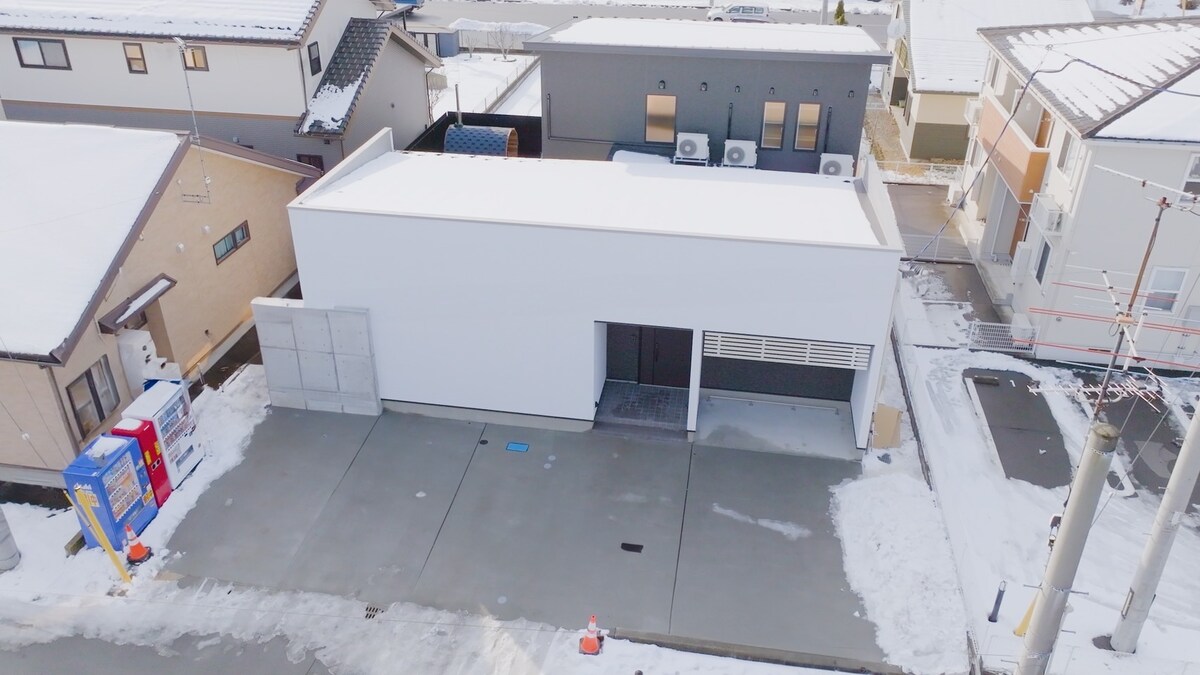
Finally, the practical part for guests staying with us. Nvillage is a little over ten minutes on foot from the west exit of Hachinohe Station; the route is on the access page. The winter caveat is wheels: the small casters on a suitcase barely roll on a pavement with snow still on it. If you are arriving with big luggage the day after a snowfall, plan on a taxi from the station. Which exit you come out of also decides where the taxi rank is, so the article on Hachinohe and Hon-Hachinohe stations is worth a look too.
Anything wet gets sorted once you are inside. There are shoe lockers at the entrance for wet boots, and the washing machine, dryer and shared drying rack are free to use, so wet socks and gloves can be dry the same evening (the laundry page). The longer you stay, the more that changes what you need to pack.
The outdoor barrel sauna is a paid option and has to be booked in advance, but winter is when guests are gladdest of it (the sauna page) — usually after a day in the sea wind, so mention it when you book rather than on the night. For the rooms themselves see the rooms page, and for what to do with your days, the area guide.
So: a shell that stops wind, waterproof shoes with grip, and gloves, ears and neck. Get those three right and the rest can be bought here. If you are still unsure what to bring, just ask us through the contact page — we can tell you what the pavements are actually like that week.