When guests ask what to do with a morning in Hachinohe, this is the first thing I suggest. It was not built for visitors: it is where the town buys its fish, and you are simply allowed to join in. Of everything within reach of the house, this is the clearest answer to why you would stay in Hachinohe at all.
But turn up at the wrong hour and there is genuinely nothing there. With guests at Nvillage I check three things the night before: is tomorrow a Sunday, is it the second Saturday of the month, and which train are you taking. Get those wrong and you travel across town to look at closed shutters. Here it is in the order I explain it.
The short answer: on a day it opens, roughly 6:30 to 10:00
- Closed on Sundays, on the second Saturday of each month, and on 1-2 January. It sometimes opens on a normally closed day before Obon or the New Year
- The market itself starts trading around 3:00, but if you come by train the earliest you can arrive is about 6:20
- The canteen inside stops serving around 10:00. There is no lunch service
- Fresh fish and sashimi stalls begin packing up before noon; dried fish and preserved goods stay open into the afternoon
So for a visitor the real window is a morning it is open, between about 6:30 and 10:00. When someone suggests leaving the house at nine, I tell them the canteen will be closing as they arrive. Days and hours do change, so check the city's page for the market before you go.
What it is: the town's kitchen since 1953
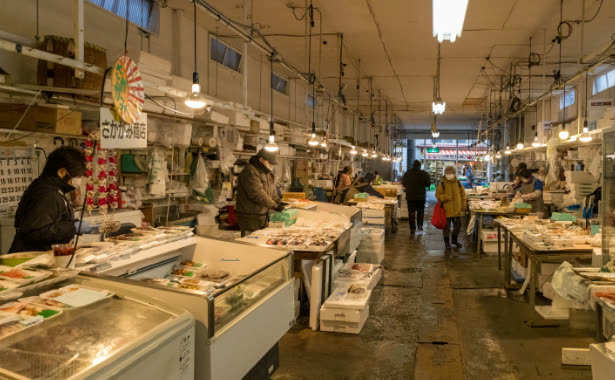
At the centre of it is the city-run fish and vegetable retail market. According to the city's own records it opened on 15 September 1953, as a municipal retail market set up to help people rebuild their livelihoods after the war, and it simply stayed on as the town's kitchen. The building was more than fifty years old and worn out by the time renovation began in 2021; the second floor was removed, leaving a single-storey hall, and it reopened in December 2022.
It did not come back as a polished tourist attraction. Inside are stalls of fresh fish, sashimi, salted and dried fish, preserved delicacies and cooked dishes, with the day's catch laid out on the counters. The women who work here have long been called isaba no katcha - isaba means someone in the fish trade, katcha is 'mother' in the local dialect. There is a statue of one of them outside the station.
More fishmongers and wholesalers continue along the streets around the station. People often picture a morning market as rows of outdoor stalls; this one is a covered hall plus the shops around it. VISIT HACHINOHE's article shows the district in photographs.
Getting there: about 17 minutes on the Hachinohe Line
Mutsu-Minato is the fourth stop from Hachinohe Station on the JR Hachinohe Line - Naganawashiro, Hon-Hachinohe, Konakano, then Mutsu-Minato - with no changes. As of September 2026 it takes about 17 minutes and costs 210 yen one way. From Hon-Hachinohe Station it is about six minutes. Hachinohe Station is the Shinkansen stop and Hon-Hachinohe is the downtown station, so which one you are staying near changes the trip.
- The line runs one or two trains an hour. Miss one and the wait is thirty minutes to an hour
- The first train out of Hachinohe Station is in the early six o'clock hour and reaches Mutsu-Minato around 6:20 - in practice, the earliest you can get there by rail
- Return trains are just as sparse, so pick the one you will take home before you start shopping
- From the ticket gate, walk along the tracks and the market is right there - one or two minutes, hard to miss
Timetables are revised every year, so look up the actual times the night before. I write the departure from the house and the train number on a piece of paper and hand it over. A taxi from Hachinohe Station takes about fifteen minutes, but there are few of them at that hour - book one the day before if you plan to rely on it. There is parking if you drive.
Building your own breakfast: buy the rice first
This is the best part of the market and the part that confuses first-timers most. There is a canteen inside called Asameshi-dokoro Gyosai, and what it sells is rice and miso soup. Nothing comes with them. You buy what goes on top from the stalls yourself, carry it back on a tray, and assemble your own breakfast.
- Buy rice and miso soup at the canteen first, and claim a seat
- Take a tray around the stalls and buy a pack of sashimi, some grilled fish, simmered dishes, salted squid - whatever looks good
- Come back and put it together. On the rice it is a seafood bowl; on a plate it is a set meal
- The canteen closes around 10:00 and does not serve lunch, so this is a morning-only affair
When someone says they have no idea what to buy, my answer is: start with one pack of sashimi and a bowl of rice, then add things as you walk. I have seen people overbuy; I have never seen anyone go hungry. Prices move with the stall and the season, so I cannot quote you a figure. Cash in small notes and coins is plenty.
Bring that cash. Some stalls take cards or electronic money, but not all of them, and this is not a place where you want to be hunting for an ATM at seven in the morning.
What to buy: to eat now, and to carry home
To eat there, start with sashimi. Fish landed at Hachinohe port reaches these counters the same day, so what is out changes with the season. Squid from summer into winter and mackerel in autumn and winter are what this port is known for; the article on saba and squid goes into when each is at its best. Stalls also sell grilled and simmered fish, so nobody is stuck if raw fish is not their thing.
What to carry home comes down to one question: will it survive a day in your bag unrefrigerated? If you are still travelling, I steer people towards preserved and dried goods rather than fresh fish. Some stalls will ship for you, which beats carrying it. If you are taking seafood out of the country, check your destination's import rules before you buy - the stall cannot answer that for you.
If you land on a closed day: Sundays belong to Tatehana
Hachinohe's two morning markets close on opposite days, which is the single most useful thing to know. Mutsu-Minato is shut on Sundays. The other one, the Tatehana quayside market, only happens on Sundays. So a Sunday morning in Hachinohe means Tatehana, and a weekday morning means Mutsu-Minato. The choice is made for you.
- Tatehana runs on Sundays from mid-March to late December. It starts at sunrise and is over by about nine. It does not run in winter
- On Sundays a shuttle bus links the town centre with the market, and the return route passes Mutsu-Minato Station, so you can see Tatehana and come back to the station afterwards. Dates and fares are on the municipal bus page
- If you have hit the second Saturday, or mornings are simply not your thing, go to Hasshoku Center instead: it opens around nine and you can grill what you buy over charcoal on the spot
After the market: what else is by the station
It is often only half past seven when you finish eating. There is a tourist information desk by the station, open through the morning hours, and it is the fastest way to find out what is open that day and where things are.
There is also a well-known small restaurant near the station serving marinated flounder over rice. It opens early and closes when the fish runs out or by early afternoon, and its closing days are not the same as the market's, so check before you count on it. Few people manage both in one morning, so in practice you pick one.
Old buildings around the station are being replaced, and the area will look different in a few years. The walkable part is small: see the market, walk a little towards the water, take the train back. That is a morning. Where to go next is on the area guide.
Things guests ask
- Language - few stalls speak English, but pointing works. Gesture the quantity and you will be understood
- With children - early on the aisles are quiet and easy to walk. Prams are awkward between the counters; carrying a small child is often easier
- Photos - ask before photographing people or their goods. This is their workplace, not a set
- Luggage - do not take a large suitcase there on your departure morning. Leave it at the house and travel light
- Clothing - floors can be wet, so wear shoes with grip. In winter the hall itself is cold
Going from Nvillage
Nvillage is a ten to twelve minute walk from the west exit of Hachinohe Station. On a market morning that means leaving the house around half past five, walking to the station and taking the first Hachinohe Line train. You will set off before it is fully light, so check the route and the times the night before.
What you carry back can go in the fridge in the shared lounge, but there is no kitchen, so nothing can be cooked here. Buy fresh fish on the assumption you will finish it that day. Where else to go afterwards is on the experiences page.
The rooms are set up for multi-night stays, so market on day one and coast on day two works well. If all you know is how many nights you have, write to us through the contact page and we will work it out with you, days of the week and train times included.